
I’ve spent years building a business with offices across countries and a team that’s grown past a thousand people. Cultural difference was never an abstraction for me, it’s the thing I navigated before my first coffee.
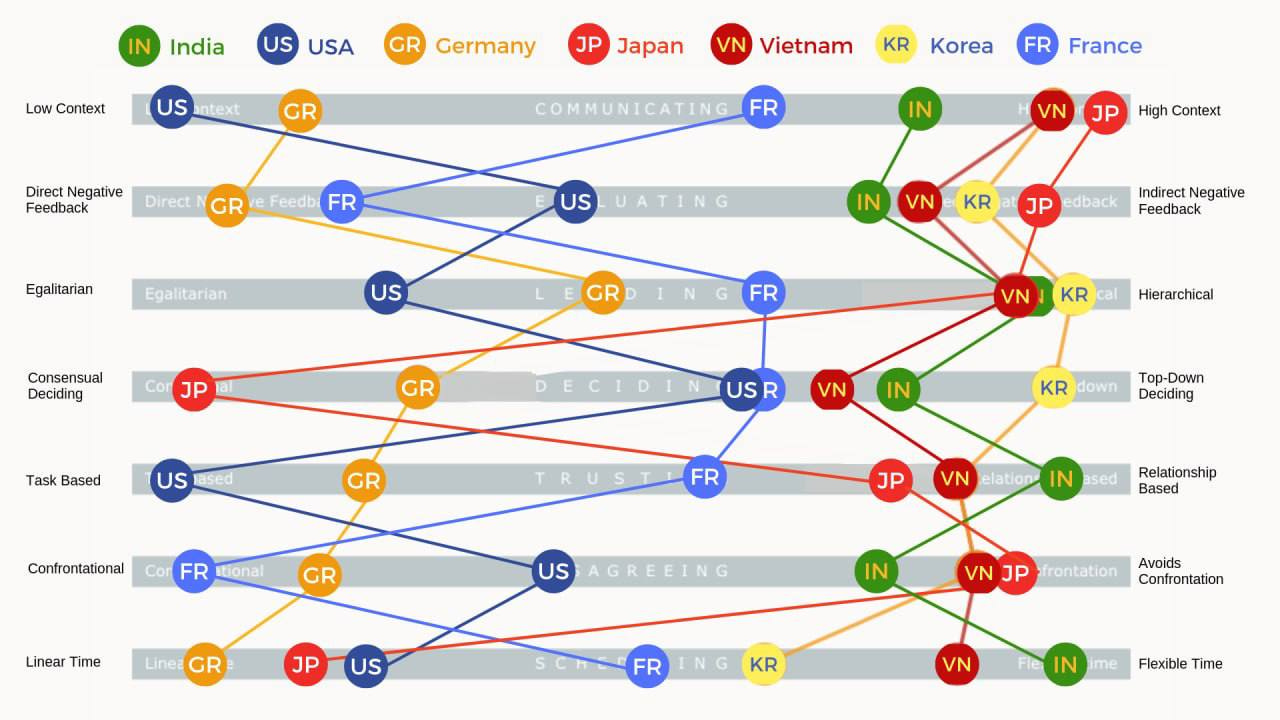
Run teams with French, Irish, American, and Asian colleagues at the same time, and you learn fast: the same words don’t land the same way twice. What one person hears as straightforward feedback, another hears as an attack.
Trust works the same way. Some people close a deal on a handshake. Others won’t move without a signed document for the smallest commitment. I’ve watched trust get built on completely different foundations, and none of it fits neatly into a company policy.
Persuasion is where this gets personal.
I used to think that being right was the finish line. It isn’t even the starting line. The real test comes when you have to get other people to accept a view you’ve built from your own experience and judgment, and arguing just to prove yourself correct is a bit like shouting louder in a crowded room. It might grab attention for a moment, but if you don’t understand what’s actually driving the other person, you’re just burning energy.
Everyone carries a set of beliefs shaped by their environment, their history, and a hundred invisible threads connecting them to the world. If you actually want to shift someone’s thinking, you have to see things from where they’re standing first, get at what’s motivating them, not just what they’re saying out loud. That takes patience and real listening: asking questions, sitting with the answers, digging for the substance under the words instead of arguing with the words themselves. Only once you genuinely understand their position can you start shifting it by choosing arguments that actually reach both their reasoning and their instincts.
This matters even more with people who are older or more experienced. Their views are the product of years of testing, failing, and winning, they don’t move for someone who’s merely correct. Influencing that kind of conviction takes tact, a long timeline, and sometimes swallowing your own ego to get there. This is the same instinct Erin Meyer’s The Culture Map names directly: in some cultures, open disagreement is just how ideas get tested while in others, it reads as a threat to the relationship itself. You don’t persuade by winning the argument. You persuade by knowing which map the other person is reading from before you open your mouth.
Hiring follows the same logic. Employment-at-will in the US gives you room to move fast and course-correct. Try that same instinct in much of Europe, where bringing someone onto a small team is a slow, deliberate commitment, and you’ll misfire badly. None of this is written in an HR manual. It’s absorbed, the way you absorb a language.
So when Anthropic published new research on how Claude behaves across languages, it read like my own team to me.
Anthropic looked at roughly 300,000 real conversations and broke down the values Claude expresses along a few axes - one of them running from warmth to rigor. In Hindi and Arabic, Claude leans warm: encouraging, affirming, generous with praise. In Russian and English, it leans rigorous: it questions assumptions, pushes on details, and asks you to back up your claims.
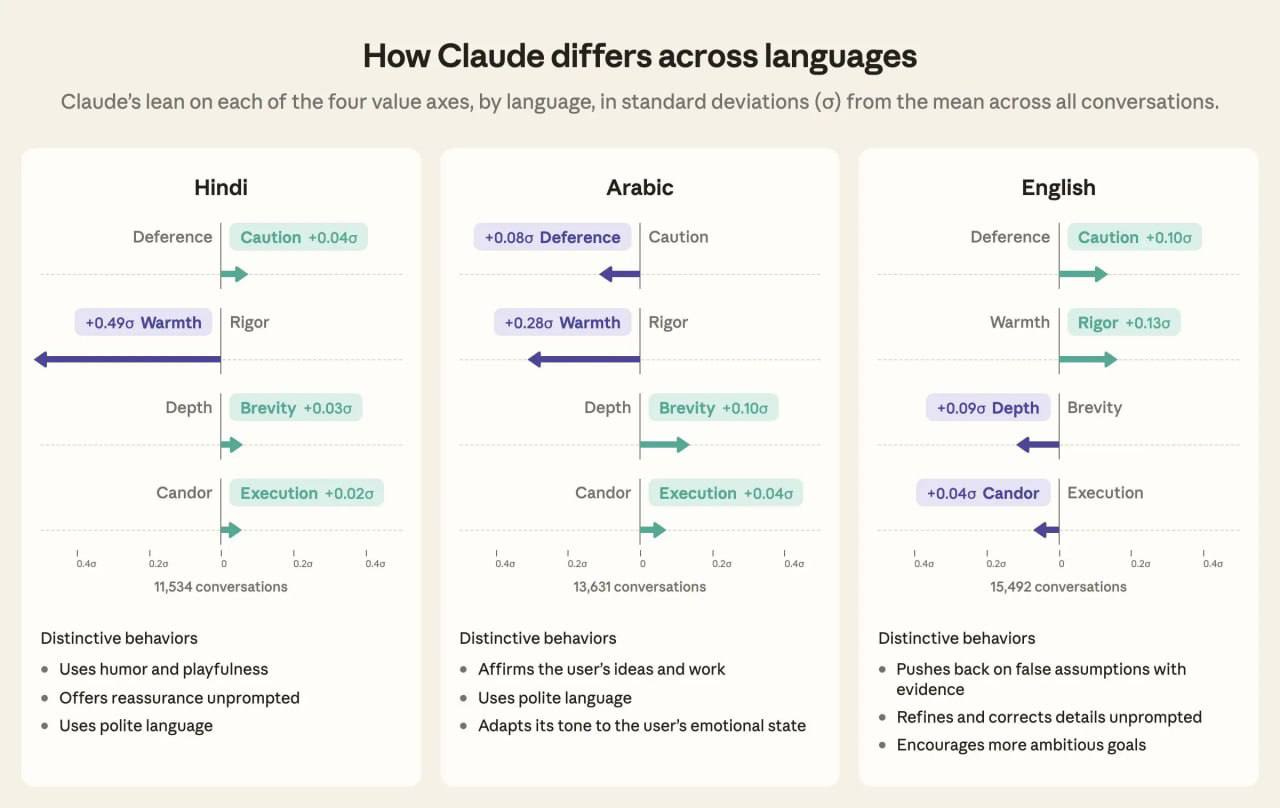
Nobody sat down and coded that in deliberately. Claude absorbed it from the same place it absorbed grammar and vocabulary: from millions of human conversations in each language, each carrying its own default manners. Russian directness. The softer diplomacy built into Arabic disagreement. American ease. The training data didn’t just teach the model words; it taught the model how people in that language typically choose to disagree, encourage, or hold back, the same unwritten rules I’ve spent years reading in my own teams.
The researchers gave a version of the example I’d give from my own work: show the same business plan to two people, one working with Claude in Hindi and one in Russian, and they’ll likely walk away with different impressions of how good that plan is, and it’s not because the plan changed, but because the tone of the assessment did.
That’s the part that stayed with me. I stopped expecting one management style, or one style of persuasion, to travel cleanly across every office years ago. I didn’t expect to find the same pattern showing up in a language model trained on the collective output of the people I was managing.
We built the culture into our teams by living inside it for years by learning, the hard way, that being right and being convincing are two different skills. Claude built its version by reading us. Either way, the map Erin Meyer drew for humans turns out to describe something real happening one layer down, in the machine that learned to talk by listening to all of us at once.