
I caught myself having an uncomfortable thought the other morning, somewhere between my first coffee and my third failed command: over the past few months, Claude Code has quietly become one of the core operating systems of my business.
It’s the primary interface through which dozens of my processes flow, the console where I spend a genuinely embarrassing share of my waking day. I don’t open it to do a task anymore. I open it the way you open a laptop lid: it’s just where the work happens.
And this morning, it wasn’t there.
X filled up within minutes with jokes about a forced digital detox - people half-celebrating the sudden, unasked-for vacation. I laughed too. Then I went quiet, because the laughter was covering something that wasn’t actually funny. I had built so much around a single endpoint that when it blinked, a meaningful slice of my day blinked with it.
We’ve Seen This Movie Before
The feeling was oddly familiar, and it took me a minute to place it. Then it landed: this is the early SaaS era all over again.
I remember the first wave of serious Salesforce rollouts. For a lot of companies, Salesforce didn’t stay a “nice CRM.” It became infrastructure: the spine that sales, support, and reporting all hung from. Which was fine, right up until it wasn’t. When something broke and the red indicators lit up on the status page, trust didn’t erode gradually. It collapsed. Clients got nervous. The market reacted. Stocks dipped on a status-page incident, because everyone understood, all at once, how much was riding on a single dependency.
Anthropic is sitting in roughly that same spot now. The growth is genuinely fantastic. But growth like that drags a heavy companion behind it: responsibility for reliability. In the consumer world you can ship fast and apologize later. In the enterprise world, trust isn’t won by a brilliant demo, it’s earned over years of boring, uneventful uptime. One great quarter of capability does not offset one bad morning of unavailability, at least not in the part of the brain that signs renewal contracts.
That’s not a criticism of Anthropic. It’s just the tax that comes with becoming critical infrastructure. Everyone who gets there pays it.
But the outage pushed me toward a sharper, more personal question, the one that isn’t really about Anthropic at all.
How Dangerous Is a Single AI Operating System?
How exposed am I, actually, building my work around one AI OS?
The question got sharper because of something else that happened recently: a new model I’d been admiring, that I’d had maybe a couple of hours to fall a little in love with got blocked before I’d even finished exploring what it could do. So now I have two failure modes stacked on top of each other: the platform can go down, and the capability I’m depending on can simply be withdrawn from under me. Neither of those is in my control. Both of them are load-bearing.
Here’s my actual stack, laid bare:
Claude Code - my primary tool. The console.
Codex - used almost exclusively for code review.
Cursor - the thing that first opened the door to vibe coding for me, and now my familiar fallback.
Gemini Coding Assistant - haven’t even tried it yet.
And the unsettling part: I have colleagues already shipping major Salesforce projects almost entirely through Cursor, no separate developers, no separate testers. The whole pipeline collapsed into one person and one tool. Incredible leverage. Also a single point of failure wearing a cape.
So the logical question writes itself: if one platform goes dark, how fast can I actually move to another and keep working?
Because the honest answer this morning was “slower than I’d like,” and that’s the gap that matters.
Maybe the real answer isn’t picking a better single tool. Maybe it’s refusing to have a single tool at all - building my own console and, more importantly, my own skills around a panel of several tools. Including, crucially, ones that don’t live on anyone else’s cloud.
Which Is Where the Home Lab Comes In
Almost a year ago I wrote about a half-serious idea I couldn’t shake, the Emergency GPT Kit. The premise was almost post-apocalyptic: a compact, offline box of local models you could pull out when the internet was gone, the cloud was off-limits, and your phone was just an expensive dead weight. A first-aid kit for the mind. The last library on earth. I framed it as a story about survival and taking back control, and I’ll admit I half-filed it under “fun thought experiment, no promises to build it.”
And that morning it stopped being a thought experiment.
Because here’s the thing: I’d already started, almost without admitting that’s what I was doing. I recently ordered a pair of ASUS Ascent GX10 units for my home lab. Only one has arrived so far, but I’ve already spun up several open-weight models on it, and the first impression genuinely surprised me.
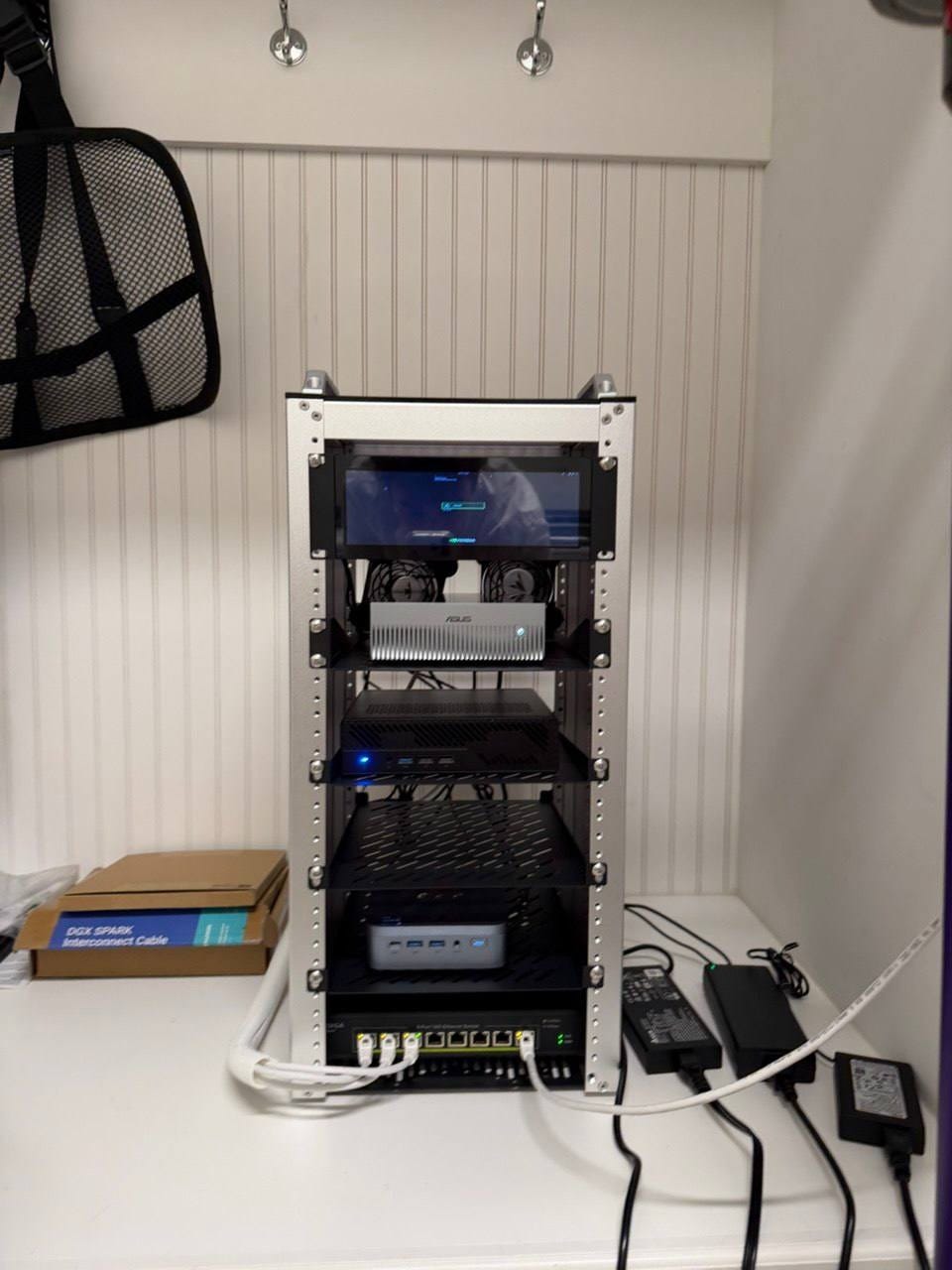
Subjectively, last year’s ChatGPT is already achievable locally. Right here. On a quiet little box on my desk. It runs fast, it’s compact, the power draw is modest, and the noise is almost nothing. A year ago that sentence would have been a press release. Now it’s just Tuesday.

Let me be clear about what it is and isn’t. It is not a replacement for Anthropic’s best models, not even close, not yet. The frontier is the frontier, and local hardware is a generation or two behind it by definition. But for a large share of my routine processes, the unglamorous middle of the workload that just needs to happen reliably, it’s already a perfectly viable backup loop. A second engine. Something that keeps turning when the primary one stalls.
That reframes the Emergency GPT Kit entirely. In the original piece I described it as insurance against catastrophe: grids failing, the long emergency, society degrading slowly over decades. All still true. But the version I actually need is far more mundane and far more immediate: insurance against a Tuesday morning when the API is down and the work still has to ship.
The Health Angle Made It Personal
There’s one category where I’ve decided the local-first approach isn’t optional, it’s the whole point.
I’m going to start analyzing my DNA and health data locally, first, before anything else. Partly that’s about privacy, which should be reason enough. But partly it’s because the frontier-hosted option for that kind of work has been narrowing: the most safety-restricted variants have been pulled back from answering medical questions at all. Whatever the reasons for that and I understand there are real ones, the practical effect on my side is the same: a capability I might want is gated or gone, on someone else’s schedule, not mine.
A local model that’s “good enough” and available beats a frontier model that’s brilliant and off-limits for the question I actually have.
And this connects to something I think about more than I’d like to admit: the slow drift toward process-oriented medicine, the kind shaped less by curiosity and more by what an insurance workflow will reimburse. The standardized path is efficient. It’s also, by design, allergic to the non-standard question, the weird symptom, the off-pattern hunch, the “what if it’s actually this” that a good doctor follows and a billing code does not. An offline, unfiltered tool I control is, among other things, a way to keep asking those questions when the system around me is optimized to skip them.
The Emergency GPT Kit is becoming a normal, sensible part of staying capable and independent.
What the Outage Actually Taught Me
We’re meticulous about backing up the wrong things.
We back up files. We back up photos. We carry a spare tire and keep a flashlight in a drawer. But over the last few years we quietly outsourced thinking itself: memory, navigation, research, drafting, increasingly judgment to services that live somewhere else, behind someone else’s status page. And we almost never back that up. When the server hiccups, our cognition hiccups with it. That’s a strange thing to have let happen.
So here’s where I’ve landed, watching my “operating system” come back online a few hours later as if nothing happened:
The AI-native company of the near future won’t be judged only by how well it uses AI. And neither will the educated, capable individual. The differentiator, the thing that separates the resilient from the merely impressive, is going to be the ability to keep working when the next model, API, or cloud suddenly isn’t available.
Capability is becoming abundant. Continuity is becoming rare. And continuity is the part you have to build yourself, on hardware you own, with skills that don’t expire the moment a connection drops.
What’s in your Emergency GPT Kit?